
Good governance is fundamental to the success and sustainability of professional bodies. Professional bodies have a distinctive role. They need to deliver value to members and customers, maintain professional standards, manage financial and organisational responsibilities and, in many cases, fulfil charitable, public-interest or Royal Charter purposes. Effective governance therefore goes beyond compliance. Boards need the capability, information and relationships required to provide strong strategic leadership and effective stewardship.
The environment is also changing rapidly. AI and digital transformation, changing member expectations, financial pressures, internationalisation and new approaches to professional learning all require Boards to look beyond today’s issues towards the future. But what does good governance actually look like in practice – and how can Boards continue to develop it?
Lessons from the Chartered Quality Institute
The LSL Group recently undertook an independent Board Performance Review of the Chartered Quality Institute (CQI), assessing Board effectiveness and governance maturity across ten Governance Domains. The Review concluded that the CQI has reached an overall level of Mature governance, with well-established governance arrangements, positive Board behaviours and an appropriate balance between strategic leadership and organisational oversight.
Importantly, the Review identified how a mature governance framework can enable strategic growth and support the Board – Executive relationship in being able to respond effectively and with agility to issues as they arise. The CQI’s opportunity is now to build upon existing strengths and continue its journey towards leading practice.
Rashad Issa, the CQI’s Chair of the Board, commented that, “It’s no surprise that at the CQI we take governance seriously. Like the profession we serve, we don’t stand still, we’re always seeking benchmarking and improvement. Working with LSL was very smooth; they created a safe space for the entire Board to contribute. Being independently recognised as operating at a high maturity level is not only rewarding, it’s reassuring; confirmation that my fellow Board members and I are giving everything we can to the success of the CQI and the profession we proudly serve.”
What can other professional bodies learn from the CQI?
The Review highlighted several areas of strength which can act as a reference point for other professional bodies. The value is not simply in recognising what the CQI does well, but in considering the governance practices behind those strengths and how they might be applied in other organisations.
Board culture matters. The CQI demonstrates how trust, openness, mutual respect and constructive challenge can create the conditions for effective strategic discussion. An environment has been created which allows opposing views to be heard and weighed on their merits, always in service of what is best for the organisation.
Inclusive Chair leadership. The CQI shows how a Chair can encourage broad participation while maintaining strategic focus and governance discipline. It means making sure quieter voices have the opportunity to be heard alongside those more confident colleagues, whilst ensuring the Board properly addresses those matters, however difficult, that require a decision.
A strong Board–Executive partnership. The CQI illustrates the value of clear roles, mutual confidence and a healthy balance between support and challenge. This partnership only works because there is both mutual trust and respect.
Governance infrastructure should enable, not constrain. The CQI’s comprehensive and proportionate arrangements provide a sound platform for effective governance. The test is simple: does this process help the CQIBoardmake better decisions, or just help prove theyfollowed one? Getting the balance right will help ensure governance becomes an asset, not a burden.
Keep the Board focused on the future. The CQI has continued to develop its Board contribution from operational oversight towards longer-term organisational success. That has meant a conscious discipline to resist getting drawn into operational detail, so that the Board’s time is spent where it matters most, namely the CQI’s long-term future.
Shared purpose strengthens governance. The CQI’s collective commitment to its purpose and the Quality profession provides a strong foundation for decision-making. Whatever background or sector Board members come from, it is that shared commitment to the profession that keeps the Board focused on its shared objectives.
From Review to action
This is where The LSL Group believes a Board Performance Review can add significantly more value. A Review should not simply produce a report and a series of recommendations and then leave the Board to determine what happens next. The opportunity is to take the Review into implementation through a dedicated workshop with the Board and the Executive Team. In the CQI’s case, the Board and the Executive Team as a whole enthusiastically engaged in this process.
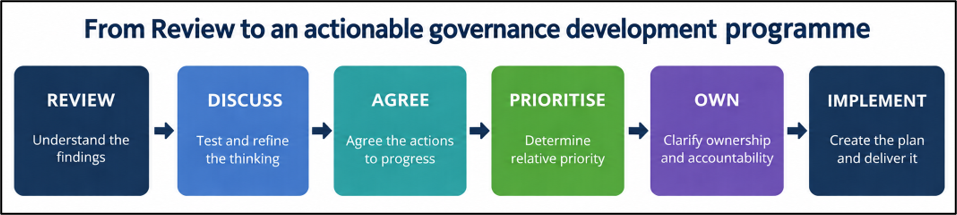
The purpose of the workshop is to turn evidence and recommendations into an agreed programme. The Board can determine which Governance Development Actions it wishes to progress, establish their relative priorities, identify ownership and accountability, explore dependencies and agree appropriate implementation timeframes. The result is not simply a Board Performance Review report, but an agreed and actionable governance development programme owned by the Board and Executive Team.
The CQI Review provides a practical example. Its 15 Governance Development Actions are intended as a coherent programme of continuous development rather than a set of corrective recommendations.
Rashad Issa emphasized that “having a Review is one thing; putting it into action is another. Seeing the Board and Executive come together to shape a strategic plan for best-in-class governance deployment has been a genuinely satisfying exercise. It is a privilege to serve the Quality Community across every part of the globe, and an honour to do so alongside my fellow Board members and the Executive team.”
From Mature to Leading Practice
In the CQI’s case moving beyond Mature governance is not about adding bureaucracy or fundamentally changing governance structures. It is about building on what already works well. For the CQI, this includes further strengthening Board succession and capability, horizon scanning, stakeholder insight, integrated reporting, digital and AI readiness and strategic risk management. The objective is to ensure that governance continues to evolve alongside the organisation and becomes an increasingly important strategic asset.
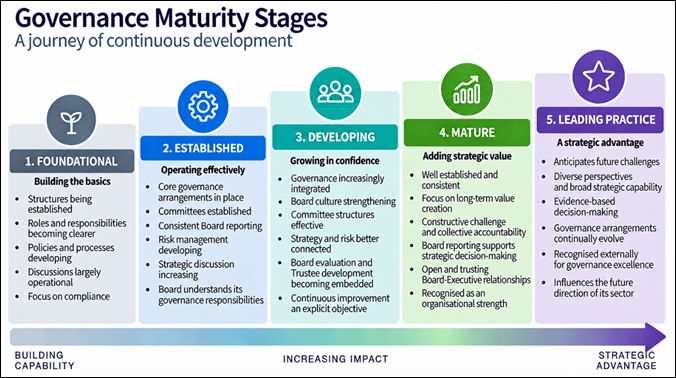
The five-stage maturity model is used as a development framework with observable indicators rather than a compliance checklist or scoring system. In the case of the CQI the assessment places the Institute at Mature governance, with a three-year ambition to achieve Leading Practice. In adopting the Framework, the CQI Board has a common reference point to assess its progress and to enable it each year to ask “What evidence demonstrates that we have moved from Mature towards Leading Practice?”.
Rashas Issa observed that “the process itself was as valuable as the findings. LSL didn’t just hand us a report — they worked with the Board and Executive to turn the evidence into a genuinely actionable governance development programme, with clear ownership and priorities. That’s what makes the difference between a Review that sits on a shelf and one that drives real change.”
The LSL Group approach
The LSL Governance Maturity Framework provides a structured methodology for assessing governance across ten interconnected Governance Domains, considering The Who, The What and The How – who governs, what the Board focuses on and how it operates. The Framework provides LSL with a consistent assessment methodology which is informed by recognized governance good practice, relevant regulatory codes, alongside evidence obtained from Board and Committee documentation, interviews, Board observation and our deep professional experience of Board effectiveness.
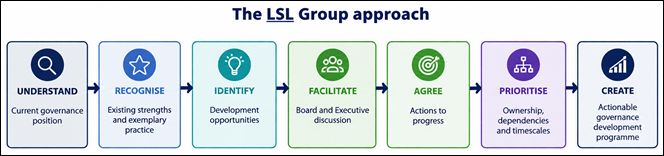
Our approach is deliberately different from a governance exercise focused solely on compliance. We seek to understand the current governance position, recognise existing strengths and exemplary practice, identify opportunities for development, facilitate Board and Executive discussion, agree the actions to progress, prioritise ownership, dependencies and timescales, and create an actionable governance development programme.
For professional bodies, this provides a practical way of moving from “How well are we governed today?” to “How do we ensure our governance continues to support our organisation and profession in the future?”
Good governance protects an organisation.
Leading governance enables it to anticipate change, make better decisions and create long-term value.
If you are interested in considering implementing an independent Review for your professional membership organisation please contact David Sneesby, CEO of The LSL Group for a confidential discussion at david.sneesby@thelslgroup.com.